Project 1
Insurance Platform
Industry: Insurance
Platform: AWS
Engagement: Data Engineering & Quality Assurance
Business Impact & Key Metrics
70%
Reduction in manual validation effort
3×
More anomalies caught pre-production
< 2 hrs
Mean time to detect pipeline failures
100%
Audit-trail coverage across pipelines
- Eliminated reliance on manual spot-checks, freeing data engineers to focus on higher-value pipeline development rather than repetitive quality verification.
- Automated regression testing reduced the risk of incorrect premium calculations or claim data reaching actuarial models, directly limiting financial liability.
- Scheduled anomaly detection ensured compliance with data lineage and quality requirements expected under insurance regulatory frameworks (e.g., Solvency II-aligned internal controls).
- End-to-end automated reporting created an always-available audit trail, enabling faster response to internal and external audits.
Solution Overview
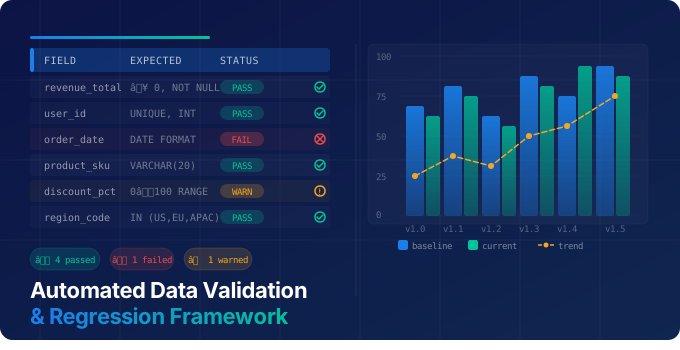
Designed and implemented an automated data validation and regression framework for the client's AWS-based Data Warehouse platform. The framework ensures data consistency, reliability, and quality across multiple data pipelines through scheduled regression checks and structured validation workflows.
Why It Mattered
In the insurance industry, data inaccuracies translate directly into financial exposure — from mispriced policies and incorrect benefit payouts to regulatory audit failures. Manual validation processes were too slow and error-prone to scale, leaving the organisation vulnerable to silent data drift across its AWS Data Warehouse. This engagement introduced a fully automated quality gate that ensured every data pipeline produced consistent, auditable, and compliant outputs before they reached downstream decision systems.
Responsibilities
- Developed and maintained Apache Airflow DAGs on AWS Managed Workflows (MWAA) to orchestrate automated regression testing pipelines.
- Built Python-based validation scripts to compare datasets across data sources, staging layers, and the Data Warehouse.
- Integrated Amazon S3 (data lake), Amazon Redshift (data warehouse), and external data sources into a unified validation workflow.
- Implemented automated workflows for data extraction & ingestion validation, schema consistency checks, and data completeness & accuracy verification.
- Designed reusable Airflow components and modular Python utilities to support scalable regression testing across multiple pipelines.
- Configured scheduled and event-driven DAG executions to monitor pipeline health and detect anomalies continuously.
- Automated reporting and logging to provide full visibility into regression test results and pipeline performance metrics.
Infrastructure & Technologies
| Component | Technology |
|---|
| Cloud Platform | AWS |
| Workflow Orchestration | Apache Airflow (AWS MWAA) |
| Programming Language | Python 3 |
| Data Warehouse | Amazon Redshift |
| Storage | Amazon S3 |
| Data Processing | Python scripts for validation & regression checks |
Architecture Flow
External Data Sources
→
Amazon S3 — Data Lake
→
AWS MWAA — Airflow DAGs (Orchestration)
→
Amazon Redshift DWH
Scheduled + Event-Driven DAG Executions | Modular Python Utilities | CloudWatch Logging
AWS
Apache Airflow
AWS MWAA
Python 3
Amazon Redshift
Amazon S3
Project 2
Media & Entertainment Platform
Industry: Media & Entertainment
Platform: AWS
Engagement: Data Engineering, PySpark & Quality Assurance
Business Impact & Key Metrics
65%
Faster detection of data quality issues
4×
More pipeline anomalies caught pre-serving
~0
Manual reconciliation effort post-deployment
99%+
Data accuracy at RDS serving layer
- Proactive schema drift detection and completeness checks prevented corrupt or incomplete data from reaching the MySQL serving layer used for ad-revenue reporting and user analytics dashboards.
- Automated incremental load validation and change tracking ensured that user engagement metrics accurately reflected platform activity, improving confidence in content performance reports.
- Data reconciliation between PySpark batch outputs and MySQL tables eliminated manual cross-checks previously performed by analysts — reducing operational overhead and risk of human error.
- Reliable analytics data enabled more accurate CPM and ad-inventory forecasting, directly protecting and improving advertising revenue streams.
- Early anomaly detection via CloudWatch alerting gave the data engineering team real-time visibility into pipeline health, reducing mean time to resolution for data incidents.
Solution Overview
Designed and implemented an automated data validation and regression framework for a digital media platform's AWS-based data infrastructure, focused on ensuring data consistency, reliability, and quality across multiple ingestion and transformation pipelines. The framework enables proactive detection of data issues through scheduled validation workflows and regression testing.
Why It Mattered
For a digital media platform, accurate analytics are the foundation of the business. Advertising revenue depends on trustworthy user engagement metrics; content investment decisions rely on clean behavioural data; and product recommendations require reliable event streams. Errors in the data ingestion or transformation pipelines — even subtle ones — cascade into inflated or deflated ad-revenue reporting, incorrect content performance metrics, and broken recommendation signals. This engagement delivered a proactive validation layer that caught data issues at every stage of the pipeline before they could distort user analytics or compromise ad-revenue accuracy.
Responsibilities
- Developed and maintained orchestration workflows using Python-based scheduling (Airflow / custom orchestration) to manage automated regression and validation pipelines.
- Built scalable PySpark validation jobs on AWS Glue to compare large datasets across ingestion layers, transformation stages, and downstream MySQL reporting tables.
- Implemented Python-based validation utilities to compare data between source systems, staging, and warehouse tables; detect schema drift; and validate completeness, duplication, and accuracy.
- Integrated Amazon S3 for raw and processed data storage, AWS Glue (PySpark) for ETL and validation processing, and Amazon RDS (MySQL) as the serving layer.
- Designed automated workflows for data ingestion validation (Source → S3 → Glue → RDS), schema validation and evolution tracking, batch-to-MySQL data reconciliation, and incremental load validation with change tracking.
- Built reusable and modular Python + PySpark validation framework components to support extensibility across multiple data pipelines.
- Configured event-driven and scheduled validation jobs in AWS Glue, enabling continuous monitoring of pipeline health and early anomaly detection.
- Implemented automated logging, alerting, and reporting via CloudWatch and custom logs to provide visibility into validation results and pipeline performance.
Infrastructure & Technologies
| Component | Technology |
|---|
| Cloud Platform | AWS |
| Workflow Orchestration | Python / AWS Glue Workflows (optional Airflow) |
| Programming Language | Python 3 |
| Data Processing | PySpark (AWS Glue) |
| Data Warehouse / Serving Layer | Amazon RDS (MySQL) |
| Storage | Amazon S3 |
| ETL & Validation | AWS Glue, PySpark, Python-based validation framework |
| Monitoring & Alerting | CloudWatch / Custom Logs |
Architecture Flow
Source Systems
→
Amazon S3 — Raw & Processed
→
AWS Glue — PySpark ETL & Validation Jobs
→
Amazon RDS — MySQL Serving
Validation at every stage | Modular PySpark + Python framework | CloudWatch Alerting
AWS
PySpark
AWS Glue
Python 3
Amazon RDS (MySQL)
Amazon S3
CloudWatch
Apache Airflow